Wednesday, October 2, 2013

Lectio prompts: John 1: 15-34

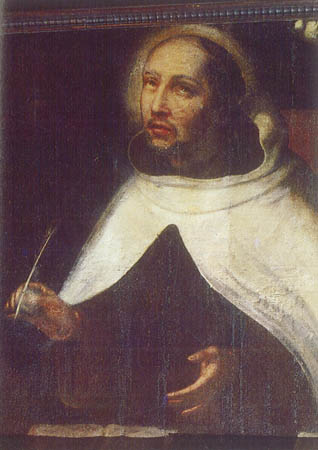
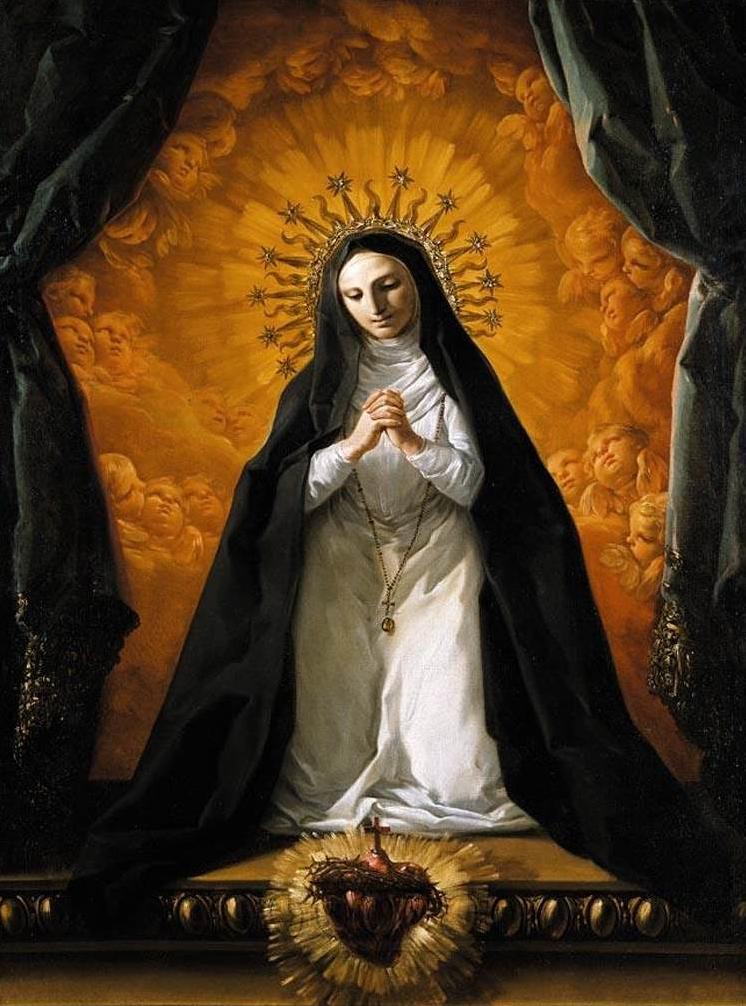
Juan de Juanes, c. 1560

For today's section of St John's Gospel, I want to propose a look at chapter 1 verses 15-34, which deal with St John the Baptist's ministry. It is a set of verses where St John emphasizes that he is not the Christ, but merely one who prepares the way for him: in John we are shown how to approach Christ with the true humility that is grounded in our understanding of who Jesus is.

Perhaps for this reason, St John the Baptist was clearly an important saint for St Benedict: his life by St Gregory the Great notes that he dedicated a chapel to the great precursor, and this has since been verified by archaeological work conducted at Monte Cassino after World War II.

Lectio

You can listen to the Latin here (and the Greek here).  And the text of both Greek and Latin, together with the Knox translation can be found here.

Latin:

Joannes testimonium perhibet de ipso, et clamat dicens: Hic erat quem dixi: Qui post me venturus est,
ante me factus est: quia prior me erat. 16  Et de plenitudine ejus nos omnes accepimus, et gratiam pro gratia: 17  quia lex per Moysen data est, gratia et veritas per Jesum Christum facta est. 18 Deum nemo vidit umquam: unigenitus Filius, qui est in sinu Patris, ipse enarravit.19 Et hoc est testimonium Joannis, quando miserunt Judæi ab Jerosolymis sacerdotes et Levitas ad eum ut interrogarent eum: Tu quis es? 20 Et confessus est, et non negavit, et confessus est: Quia non sum ego Christus. 21 Et interrogaverunt eum: Quid ergo? Elias es tu? Et dixit: Non sum. Propheta es tu? Et respondit: Non. 22 Dixerunt ergo ei: Quis es ut responsum demus his qui miserunt nos? quid dicis de teipso? 23 Ait: Ego vox clamantis in deserto: Dirigite viam Domini, sicut dixit Isaias propheta. 24 Et qui missi fuerant, erant ex pharisæis. 25 Et interrogaverunt eum, et dixerunt ei: Quid ergo baptizas, si tu non es Christus, neque Elias, neque propheta? 26 Respondit eis Joannes, dicens: Ego baptizo in aqua: medius autem vestrum stetit, quem vos nescitis. 27 Ipse est qui post me venturus est, qui ante me factus est: cujus ego non sum dignus ut solvam ejus corrigiam calceamenti. 28 Hæc in Bethania facta sunt trans Jordanem, ubi erat Joannes baptizans. 29 Altera die vidit Joannes Jesum venientem ad se, et ait: Ecce agnus Dei, ecce qui tollit peccatum mundi. 30 Hic est de quo dixi: Post me venit vir qui ante me factus est: quia prior me erat: 31 et ego nesciebam eum, sed ut manifestetur in Israël, propterea veni ego in aqua baptizans. 32 Et testimonium perhibuit Joannes, dicens: Quia vidi Spiritum descendentem quasi columbam de cælo, et mansit super eum. 33 Et ego nesciebam eum: sed qui misit me baptizare in aqua, ille mihi dixit: Super quem videris Spiritum descendentem, et manentem super eum, hic est qui baptizat in Spiritu Sancto. 34 Et ego vidi: et testimonium perhibui quia hic est Filius Dei.

The English:

[15] John beareth witness of him, and crieth out, saying: This was he of whom I spoke: He that shall come after me, is preferred before me: because he was before me. [16] And of his fulness we all have received, and grace for grace. [17] For the law was given by Moses; grace and truth came by Jesus Christ. [18] No man hath seen God at any time: the only begotten Son who is in the bosom of the Father, he hath declared him. [19] And this is the testimony of John, when the Jews sent from Jerusalem priests and Levites to him, to ask him: Who art thou? [20] And he confessed, and did not deny: and he confessed: I am not the Christ. [21] And they asked him: What then? Art thou Elias? And he said: I am not. Art thou the prophet? And he answered: No. [22] They said therefore unto him: Who art thou, that we may give an answer to them that sent us? What sayest thou of thyself? [23] He said: I am the voice of one crying out in the wilderness, make straight the way of the Lord, as said the prophet Isaias. [24] And they that were sent, were of the Pharisees. [25] And they asked him, and said to him: Why then dost thou baptize, if thou be not Christ, nor Elias, nor the prophet? [26] John answered them, saying: I baptize with water; but there hath stood one in the midst of you, whom you know not. [27] The same is he that shall come after me, who is preferred before me: the latchet of whose shoe I am not worthy to loose. [28] These things were done in Bethania, beyond the Jordan, where John was baptizing. [29] The next day, John saw Jesus coming to him, and he saith: Behold the Lamb of God, behold him who taketh away the sin of the world. [30] This is he, of whom I said: After me there cometh a man, who is preferred before me: because he was before me. [31] And I knew him not, but that he may be made manifest in Israel, therefore am I come baptizing with water. [32] And John gave testimony, saying: I saw the Spirit coming down, as a dove from heaven, and he remained upon him. [33] And I knew him not; but he who sent me to baptize with water, said to me: He upon whom thou shalt see the Spirit descending, and remaining upon him, he it is that baptizeth with the Holy Ghost. [34] And I saw, and I gave testimony, that this is the Son of God.

Studio

These verses emphasis both the continuity of Christ's mission, perfecting the law through grace; its sacrificial nature, with the reference to the lamb of God; and the revelation of the Trinitarian nature of God.

Why was John's testimony so important?  The Catena Aurea's explanations include these:

"ORIGEN; The Jews of Jerusalem, as being of kin to the Baptist, who was of the priestly stock, send Priests and Levites to ask him who he is; that is, men considered to hold a superior rank to the rest of their order, by God's election, and coming from that favored above all cities, Jerusalem. Such is the reverential way in which they interrogate John. We read of no such proceeding towards Christ: but what the Jews did to John, John in turn does to Christ, when he asks Him, through His disciples, Are you He that should come, or look we for another? 

CHRYS. Such confidence had they in John, that they were ready to believe him on his own words: witness how it is said, To ask him, Who are you?

AUG. They would not have sent, unless they had been impressed by his lofty exercise of authority, in daring to baptize. 

ORIGEN; John, as it appears, saw from the question, that the Priests and Levites had doubts whether it might not be the Christ, who was baptizing; which doubts however they were afraid to profess openly, for fear of incurring the charge of credulity. He wisely determines therefore first to correct their mistake, and then to proclaim the truth. 

Accordingly, he first of all shows that he is not the Christ: And he confessed, and denied not; but confessed, I am not the Christ. We may add here, that at this time the people had already begun to be impressed with the idea that Christ's advent was at hand, in consequence of the interpretations which the lawyers had collected out of the sacred writings to that effect. Thus Theudas had been enabled to collect together a considerable body, on the strength of his pretending to be the Christ; and after him Judas, in the days of the taxation, had done the same. Such being the strong expectation of Christ's advent then prevalent, the Jews send to John, intending by the question, Who are you? to extract from him whether he were the Christ. 

GREG. He denied directly being what he was not, but he did not deny what he was: thus, by his speaking truth, becoming a true member of Him Whose name he had not dishonestly usurped. 

CHRYS. Or take this explanation: The Jews were influenced by a kind of human sympathy for John, whom they were reluctant to see made subordinate to Christ, on account of the many marks of greatness about him; his illustrious descent in the first place, he being the son of a chief priest; in the next, his hard training, and his contempt of the world. Whereas in Christ the contrary were apparent; a humble birth, for which they reproach Him; Is not this the carpenter's son? an ordinary way of living; a dress such as every one else wore. 

As John then was constantly sending to Christ, they send to him, with the view of having him for their master, and thinking to induce him, by blandishments, to confess himself Christ. They do not therefore send inferior persons to him, ministers and Herodians, as they did to Christ, but Priests and Levites; and not of these an indiscriminate party, but those of Jerusalem, i.e. the more honorable ones; but they send them with this question, to ask, Who are you? not from a wish to be informed, but in order to induce him to do what I have said. John replies then to their intention, not to their interrogation: And he confessed, and denied not; but confessed, I am not the Christ. 

And observe the wisdom of the Evangelist: he repeats the same thing three times, to show John's virtue, and the malice and madness of the Jews. For it is the character of a devoted servant, not only to forbear taking to himself his lord's glory, but even, when numbers offer it to him, to reject it. The multitude indeed believed from ignorance that John was the Christ, but in these it was malice; and in this spirit they put the question to him, thinking, by their blandishments to bring him over to their wishes. 

For unless this had been their design, when he replied, I am not the Christ, they would have said, We did not suspect this; we did not come to ask this. When caught, however, and discovered in their purpose, they proceed to another question: And they asked him, What then? Are you Elias?

AUG. For they knew that Elias was to preach Christ; the name of Christ not being unknown to any among the Jews; but they did not think that our Lord was the Christ: and yet did not altogether imagine that there was no Christ about to come. In this way, while looking forward to the future, they mistook at the present.

 And he said, I am not...

GREG. But if we examine the truth accurately, that which sounds inconsistent, will be found not really so. The Angel told Zacharias concerning John, He shall go before Him in the spirit and power of Elias. As Elias then will preach the second advent of our Lord, so John preached His first; as the former will come as the precursor of the Judge, so the latter was made the precursor of the Redeemer. John was Elias in spirit, not in person: and what our Lord affirms of the spirit, John denies of the Person: there being a kind of propriety in this; viz. that our Lord to His disciples should speak spiritually of John, and that John, in answering the carnal multitude, should speak of his body, not of his spirit... 

ORIGEN; There is need of the voice crying in the wilderness, that the soul, forsaken by God, may be recalled to making straight the way of the Lord, following no more the crooked paths of the serpent. This has reference both to the contemplative life, as enlightened by truth, without mixture of falsehood, and to the practical, as following up the correct perception by the suitable action. Wherefore he adds, Make straight the way of the Lord, as said the prophet Esaias. 

GREG. The way of the Lord is made straight to the heart, when the word of truth is heard with humility; the way of the Lord is made straight to the heart, when the life is formed upon the precept."

Meditatio

In a sermon for Advent of 2011, which you can find along with a compilation of commentaries by the Fathers, Theologians and the Magisterium at the useful Bibliaclerus site, Pope Benedict XVI noted:

"...John had withdrawn into the wilderness to live a very austere life and to invite people to conversion, also by the example of his life. He conferred on them a baptism of water, a single rite of penance which distinguished it from the many rites of external purification of the sects of that time.

So who was this man? Who was John the Baptist? The response he himself gave is surprisingly humble. He was not the Messiah, he was not the light. He was neither Elijah come back to the earth nor the great prophet awaited. He was the Forerunner, a simple witness, totally subordinate to the One he proclaimed; a voice in the wilderness, as in our day too, in the wilderness of the great cities of this world, of the great absence of God, we need voices that simply announce to us “God exists. He is always near, even if he seems absent”.

John the Baptist was a voice in the wilderness and a witness to the light; and this moves our hearts, for in this world where there are so many shadows, so much darkness, we are all called to be witnesses of light...and we can only be this if we carry the light within us, if we are not only certain that the light exists, but also that we have seen a ray of light.

In the Church, in God’s word, in the celebration of the sacraments, in the Sacrament of Confession with the forgiveness that we receive, in the celebration of the Blessed Eucharist where the Lord gives himself into our hands and hearts, we touch the light and receive this mission: to bear witness today that there is light, and to carry the light in our time."


You can find notes on the next section of St John's Gospel, dealing with the calling of the disciples, here.

Tuesday, October 1, 2013

Lectio Divina prompts: John 1:1-14


Yesterday I provided some notes on how to approach lectio divina in the Benedictine tradition, and suggested committing to prayerful reading of St John's Gospel during this quarter.  Accordingly, today, a few notes to help encourage you to get started.

The opening of St John's Gospel, of course, is said as the Last Gospel in every traditional Mass.

But because it's only place in the main cycle of Gospel readings is on Christmas Day, it is rarely the subject of sermons.  Accordingly, some prompts to aid your study, meditation, prayer and contemplation of John 1:1-14.

Read

First, listen to the Latin, following along with the text.  Then read it aloud yourself.

Unfortunately there are, as far as I can find, no versions of the complete New Testament, or even the Gospel of John, read with ecclesiastical pronunciation (do let me know if you are aware of any though!).  But you can hear the whole text read with Latin classical pronunciation from the excellent Greek and Latin audio site here (to 1.25).

Alternatively, the video below provides a line by line version of John 1 read first from the Douay-Rheims translation, followed by the Vulgate Latin (to 3.47).

In principio erat Verbum, et Verbum erat apud Deum, et Deus erat Verbum. 2 Hoc erat in principio apud Deum. 3 Omnia per ipsum facta sunt: et sine ipso factum est nihil, quod factum est. 4 In ipso vita erat, et vita erat lux hominum: 5 et lux in tenebris lucet, et tenebræ eam non comprehenderunt. Fuit homo missus a Deo, cui nomen erat Joannes. 7 Hic venit in testimonium ut testimonium perhiberet de lumine, ut omnes crederent per illum. 8 Non erat ille lux, sed ut testimonium perhiberet de lumine. 9  Erat lux vera, quæ illuminat omnem hominem venientem in hunc mundum. 10  In mundo erat, et mundus per ipsum factus est, et mundus eum non cognovit. 11 In propria venit, et sui eum non receperunt. 12
Quotquot autem receperunt eum, dedit eis potestatem filios Dei fieri, his qui credunt in nomine ejus: 13 qui non ex sanguinibus, neque ex voluntate carnis, neque ex voluntate viri, sed ex Deo nati sunt. 14
Et Verbum caro factum est, et habitavit in nobis: et vidimus gloriam ejus, gloriam quasi unigeniti a Patre plenum gratiæ et veritatis.


For the English, I personally think the best translation is the Knox one.  You can find it online (along with the Greek for those interested) at the fabulous New Advent site (and if you want to hear the Greek, listen here).

Here though is the Douay Rheims (updated version):

"In the beginning was the Word, and the Word was with God, and the Word was God. [2] The same was in the beginning with God. [3] All things were made by him: and without him was made nothing that was made. [4] In him was life, and the life was the light of men. [5] And the light shineth in darkness, and the darkness did not comprehend it. [6] There was a man sent from God, whose name was John. [7] This man came for a witness, to give testimony of the light, that all men might believe through him. [8] He was not the light, but was to give testimony of the light. [9] That was the true light, which enlighteneth every man that cometh into this world. [10] He was in the world, and the world was made by him, and the world knew him not. [11] He came unto his own, and his own received him not. [12] But as many as received him, he gave them power to be made the sons of God, to them that believe in his name. [13] Who are born, not of blood, nor of the will of the flesh, nor of the will of man, but of God. [14] And the Word was made flesh, and dwelt among us, (and we saw his glory, the glory as it were of the only begotten of the Father,) full of grace and truth."

To aid your study

Once you have the text in your mind, focus on the overall message of it.  These extracts from the Catena Aurea may help:

"BEDE; The other Evangelists describe Christ as born in time; John witnesses that He was in the beginning, saying, In the beginning was the Word. The others describe His sudden appearance among men; he witnesses that He was ever with God, saying, And the Word was with God. The others prove Him very man; he very God, saying, And the Word was God. The others exhibit Him as man conversing with men for a season; he pronounces Him God abiding with God in the beginning, saying, The Same was in the beginning with God. The others relate the great deeds which He did amongst men; he that God the Father made every creature through Him, saying, All things were made by Him, and without Him was not any shiny made.

CHRYS. While all the other Evangelists begin with the Incarnation, John, passing over the Conception, Nativity, education, and growth, speaks immediately of the Eternal Generation, saying, In the beginning was the Word.

AUG. The Greek word "logos" signifies both Word and Reason. But in this passage it is better to interpret it Word; as referring not only to the Father, but to the creation of things by the operative power of the Word; whereas Reason, though it produce nothing, is still rightly called Reason..

BASIL; This Word is not a human word. For how was there a human word in the beginning, when man received his being last of all? There was not then any word of man in the beginning, nor yet of Angels; for every creature is within the limits of time, having its beginning of existence from the Creator. But what says the Gospel? It calls the Only-Begotten Himself the Word.

CHRYS. But why omitting the Father, does he proceed at once to speak of the Son? Because the Father was known to all; though not as the Father, yet as God; whereas the Only-Begotten was not known. As was meet then, he endeavors first of all to inculcate the knowledge of the Son on those who knew Him not; though neither in discoursing on Him, is he altogether silent on the Father. And inasmuch as he was about to teach that the Word was the Only-Begotten Son of God, that no one might think this a possible generation, he makes mention of the Word in the first place, in order to destroy the dangerous suspicion, and show that the Son was from God impassibly. And a second reason is, that He was to declare to us the things of the Father. But he does not speak of the Word simply, but with the addition of the article, in order to distinguish It from other words. For Scripture calls God's laws and commandments words; but this Word is a certain Substance, or Person, an Essence, coming forth impassibly from the Father Himself.

BASIL; Wherefore then Word? Because born impassibly, the Image of Him that begat, manifesting all the Father in Himself; abstracting from Him nothing, but existing perfect in Himself.

For Meditation

I would then suggest picking out one or two verses that seem particularly meaningful to you, then using some of the Patristic commentaries from the Catena Aurea to extract the juice from it.  Here is an example of the kind of material the Catena provides:

CHRYS. Observe the spiritual wisdom of the Evangelist. He knew that men honored most what was as most ancient, and that honoring what is before every thing else, they conceived of it as God. On this account he mentions first the beginning, saving, In the beginning was the Word.

ORIGEN; There are many significations of this word beginning. For there is a beginning of a journey, and beginning of a length, according to Proverbs, The beginning of the right path is to do justice. There is a beginning too of a creation, according to Job, He is the beginning of the ways of God. Nor would it be incorrect to say, that God is the Beginning of all things. The preexistent material again, where supposed to be original, out of which any thing is produced, is considered as the beginning. There is a beginning also in respect of form: as where Christ is the beginning of those who are made according to the image of God. And there is a beginning of doctrine, according to Hebrews; When for the time you ought to be teachers, you have need that one teach you again which be the first principles of the oracles of God. For there are two kinds of beginning of doctrine: one in itself, the other relative to us; as if we should say that Christ, in that He is the Wisdom and Word of God, was in Himself the beginning of wisdom, but to us, in that He was the Word incarnate. There being so many significations then of the word, we may take it as the Beginning through Whom, i.e. the Maker; for Christ is Creator as The Beginning, in that He is Wisdom; so that the Word is in the beginning, i.e. in Wisdom; the Savior being all these excellences at once. As life then is in the Word, so the Word is in the Beginning, that is to say, in Wisdom. Consider then if it be possible according to this signification to understand the Beginning, as meaning that all things are made according to Wisdom, and the patterns contained therein; or, inasmuch as the Beginning of the Son is the Father, the Beginning of all creatures and existences, to understand by the text, In the beginning was the Word, that the Son, the Word, was in the Beginning, that is, in the Father...

CHRYS. Life having come to us, the empire of death is dissolved; a light having shone upon us, there is darkness no longer: but there remains ever a life which death, a light which darkness cannot overcome. Whence he continues, And the light shines in darkness: by darkness meaning death and error, for sensible light does not shine in darkness, but darkness must be removed first; whereas the preaching of Christ shone forth amidst the reign of error, and caused it to disappear, and Christ by dying changed death into life, so overcoming it, that, those who were already in its grasp, were brought back again. Forasmuch then as neither death nor error has overcome his light, which is every where conspicuous shilling forth by its own strength; therefore he adds, And the darkness comprehended it not.

Pray, contemplate and work

The next stages of lectio must be an individual process: they involving turning the insights gained through our meditation into prayer; contemplating those insights, and considering how they should change our behaviour and thinking; and then putting these changes into action.

You can find notes on the next section of St John 1 (verses 15-34) here.

Monday, September 30, 2013

Lectio Divina in the Benedictine tradition: tackling the Gospel of St John

Today is the feast of St Jerome, a saint most famous as a translator of the Bible into the vernacular of the time, viz Latin.

In these difficult times, it seems more important than ever that Catholics devote themselves to reading Scripture, both in order to feed their own souls, and so as to be able to assess for themselves the various claims of what Scripture does and does not say.

And of course St Benedict's Rule prescribes a lot of hours of lectio divina, or meditative reading, generally of Scripture.

Accordingly, I thought it might be an appropriate moment to encourage readers to commit to reading St John's Gospel this quarter.

How much can we do - a Bible Reading Plan?

Laypeople will of course, not generally be able to devote the two or three hours that St Benedict prescribes for the task of lectio divina each day.  Still, we can try and do at least a little each day.

An excellent article over at New Liturgical Movement, with associated Bible Reading Plan, from Dom Christopher Lazowski, OSB, a few years ago, suggests that the traditional approach for a monk was to read the Bible in a year.

The psalms of course are read each week, in the Office.

The books other than the Gospels can be read following the broad seasonal ordering set by the Matins readings, and he sets out a couple of schemas there based around this.  Getting through all of the books in a year is a pretty challenging task:  most people living in the world might want to consider a two or three year cycle instead, or perhaps just using the selections of the chapters from the Roman Breviary (which you can find on the Divinum Officium website at Matins); alternatively you could consider doing the Gospels one year, the rest the next.

And the Gospels, of course, can be tackled one for each quarter.  I'm going to focus on that here, looking at St John's Gospel.

Tackling St John's Gospel

In order to read the whole of St John's Gospel (21 chapters) in the course of the quarter (and allowing time out for Sundays, major feasts and Christmastide), you basically need to get through a chapter every two or three days.

Accordingly, I'd suggest trying to read 15-20 verses a day, and focusing in on just a couple of them.

How monks read: doing real lectio

These days lectio divina is often reduced to nothing much more than reading a  few verses, and seeking to come up with one's own entirely subjective response to it.

This is, in my view, an entirely modernist approach that de facto promotes a 'sola scriptura' mentality entirely at odds with the Church's traditional approach to the interpretation of Scripture.

And it is also extremely hard to do for more than half an hour or so, which perhaps explains in part why most modern monasteries don't devote anything like as much time to the task as St Benedict specifies in his Rule.

Traditionally, lectio was a much more intellectual and engaging process.

Unfortunately, reading Scripture in the mind of the Church is not an easy task, for their are relatively few good resources around to assist one.

That's not to say that you need a great theological education to read Scripture of course: just that you need to be given a few tools, like access to a good commentary, to help you as you go.

Dom Paul Delatte's famous Commentary on the Rule of St Benedict nicely captures this, I think, with his summation of the stages of lectio divina as read, think, study, meditate, pray, contemplate, work.

Today, a short rundown on each of these stages of the process by way of an introduction.  You can find more detailed notes on this subject from the links in a sidebar on my Psalm Blog.

Active reading

The first stage of lectio, 'reading' meant much more than just quickly and quietly reading a verse or two as we tend to think of reading.

Rather, it meant reading it out loud, and puzzling out the Latin.  Accordingly, I'm going to provide the text in each post Latin as well as English, together with a link to an audio recording of it.  Even if you don't have any Latin, you can acquire some through the immersion method, and join yourselves to the struggle of those medieval monks, many of whom would have learnt it exactly the same way!

It also meant actually memorizing the text, at least sufficiently well so that you could continue to chew over key sections of it for the rest of the day while doing your manual labour.

Thinking

In order to read Scripture properly, we need to consider both the literal and spiritual senses of the text, as the Catechism (CCC 116-117) explains:

  • "The literal sense is the meaning conveyed by the words of Scripture and discovered by exegesis, following the rules of sound interpretation...
  • The spiritual sense. Thanks to the unity of God's plan, not only the text of Scripture but also the realities and events about which it speaks can be signs. 
The spiritual sense includes:
  • "the allegorical sense. We can acquire a more profound understanding of events by recognizing their significance in Christ; thus the crossing of the Red Sea is a sign or type of Christ's victory and also of Christian Baptism;
  • the moral sense. the events reported in Scripture ought to lead us to act justly. As St. Paul says, they were written "for our instruction";
  • the anagogical sense (Greek: anagoge, "leading"). We can view realities and events in terms of their eternal significance, leading us toward our true homeland: thus the Church on earth is a sign of the heavenly Jerusalem."
Some of this may become obvious to us as we read through the aid of the Holy Ghost.  But we cannot rely solely on inspiration, when perspiration is what God prescribes!

Study

That means reading our text in the light of the rest of Scripture, and the Church's reflections on it.

As the writings of the Fathers attest, a particular verse should never be read in isolation from the rest of the Bible: rather the New is read in the light of the Old, and the Old in the light of the New.  That means being aware of the direct or indirect cross-references to a verse in other parts of Scripture.

Some of the direct cross-references can readily be found in standard Catholic commentaries such as the Navarre Bible, or Haydock's Catholic Bible Commentary.  The medieval system went further than this though, often weaving a web of meaning from verses that used of the same word.  Online tools like the cross-referencing provided by the Blue letter Bible can help you recreate this approach if you choose!

And in terms of Patristic and other commentaries, there are a number of good sources: the Catena Aurea compiled by St Thomas Aquinas and translated by Blessed Cardinal Newman is an excellent starting point for example.

Meditation and prayer

The meditation stage should flow naturally from our study of the text: through it we consider the meaning of the events or words for us in particular and ask for God's help in applying it to our lives.

Contemplation and work

Scripture should become for us a mirror, in which we can hold up our lives and be judged against its measure.  Through contemplation, we can see what we need to change in the future, and then work on implementing the necessary change in our lives.

The first part in a series of notes to assist you in this process, on St John's Gospel, can be found here.

Thursday, August 15, 2013

Feast of the Assumption


The Benedictine Office this week:

Sun 11 Aug Twelfth Sunday after Pentecost, Class II; St. Tiburtius, Memorial
Mon 12 Aug Class IV; St. Clare, Memorial
Tues 13 Aug Class IV; SS Pontianus, Pope and Hippolytus, Memorial
Wed 14 Aug Vigil of the Assumption, Class II          
Thurs 15         Assumption of the Blessed Virgin Mary, Class I
Fri 16 Aug Class IV
Sat 17 Aug Saturday of Our Lady

Saturday, January 26, 2013

The season of Septuagesima

From 1 Vespers on Saturday, 26 January this year, we enter the season of Septuagesima, or Shrovetide.

Septuagesima was abolished in the Ordinary Form calendar, and indeed isn't mentioned in St Benedict's Rule either, but it has a long history, dating back to the reforms of Pope Gregory the Great.

The original concept was to form something of a bridge between the joyful season of Christmastide (which covered the forty days up to February 2), and the penitential season of Lent.

The main liturgical feature of Septuagesima is that the alleluia is no longer used. Indeed, tonight at Vespers it is solemnly 'buried' with a double alleluia added to the  closing versicle to the hour.  Thereafter, it is replaced by 'Laus tibi Domine, Rex aeternae gloriae' in the opening prayers for each hour.

The liturgy also becomes a little more solemn with the addition of a Magnificat canticle proper to each day.

Saturday, January 12, 2013

Commemoration of Our Lord's Baptism


This Sunday marks the final end of the Christmas (and Epiphany) season, with the Commemoration of Our Lord's Baptism.

For details of the feasts this week, and how to reflect them in the Office, please take a look at the Ordo for January.

Happy Christmas!

Tuesday, December 25, 2012

Merry Christmas!


Wishing you a happy and holy Christmas!

Thursday, November 29, 2012

Chant from Le Barroux

I've been meaning to alert readers to a new site providing sound files of the Office from the french traditionalist monastery of Le Barroux.

Le Barroux provides live streaming of some of its Offices from its own site, but that isn't much help for those of us living in very different time zones!

Accordingly, an American group has set up a site called The Chant of Le Barroux  to help bridge the timezones.

So now you can compare and contrast the French/Solesmes style with the more robust Italo-American of Norcia!

Le Barroux's 2013 Ordo is also available on their website for Oblates of that monastery - note that it is in Latin only, and their calendar and rubrics differ somewhat from that specified in the 1962-3 Monastic Breviary (in particular, they have retained I Vespers for Second Class feasts and the Office of Our Lady on Saturday, and include a number of feasts from the EF and French calendars).


Saturday, November 24, 2012

St John of the Cross, Memorial (November 24)


St John of Avila was declared a doctor of the Church earlier this year.

Friday, November 23, 2012

St Clement I (November 23)


From the martyrology:

"The birthday of Pope St. Clement, who held the sovereign Pontificate the third after the blessed Apostle Peter. In the persecution of Trajan, he was banished to Chersonesus, where, being precipitated into the sea with an anchor tied to his neck, he was crowned with martyrdom. His body was taken to Rome during the pontificate of Nicholas I, and placed with due honors in the church which had been previously built under his invocation."

Pope Benedict XVI gave a General Audience on St Clement in 2007:

"St Clement, Bishop of Rome in the last years of the first century, was the third Successor of Peter, after Linus and Anacletus. The most important testimony concerning his life comes from St Irenaeus, Bishop of Lyons until 202. He attests that Clement "had seen the blessed Apostles", "had been conversant with them", and "might be said to have the preaching of the apostles still echoing [in his ears], and their traditions before his eyes" (Adversus Haer. 3, 3, 3).

Later testimonies which date back to between the fourth and sixth centuries attribute to Clement the title of martyr.

The authority and prestige of this Bishop of Rome were such that various writings were attributed to him, but the only one that is certainly his is the Letter to the Corinthians. Eusebius of Caesarea, the great "archivist" of Christian beginnings, presents it in these terms: "There is extant an Epistle of this Clement which is acknowledged to be genuine and is of considerable length and of remarkable merit. He wrote it in the name of the Church of Rome to the Church of Corinth, when a sedition had arisen in the latter Church. We know that this Epistle also has been publicly used in a great many Churches both in former times and in our own" (Hist. Eccl. 3, 16).

An almost canonical character was attributed to this Letter. At the beginning of this text - written in Greek - Clement expressed his regret that "the sudden and successive calamitous events which have happened to ourselves" (1, 1) had prevented him from intervening sooner. These "calamitous events" can be identified with Domitian's persecution: therefore, the Letter must have been written just after the Emperor's death and at the end of the persecution, that is, immediately after the year 96.

Clement's intervention - we are still in the first century - was prompted by the serious problems besetting the Church in Corinth: the elders of the community, in fact, had been deposed by some young contestants. The sorrowful event was recalled once again by St Irenaeus who wrote: "In the time of this Clement, no small dissension having occurred among the brethren in Corinth, the Church in Rome dispatched a most powerful Letter to the Corinthians exhorting them to peace, renewing their faith and declaring the tradition which it had lately received from the Apostles" (Adv. Haer. 3, 3, 3).

Thus, we could say that this Letter was a first exercise of the Roman primacy after St Peter's death. Clement's Letter touches on topics that were dear to St Paul, who had written two important Letters to the Corinthians, in particular the theological dialectic, perennially current, between the indicative of salvation and the imperative of moral commitment.

First of all came the joyful proclamation of saving grace. The Lord forewarns us and gives us his forgiveness, gives us his love and the grace to be Christians, his brothers and sisters.
It is a proclamation that fills our life with joy and gives certainty to our action: the Lord always forewarns us with his goodness and the Lord's goodness is always greater than all our sins.

However, we must commit ourselves in a way that is consistent with the gift received and respond to the proclamation of salvation with a generous and courageous journey of conversion.

In comparison with the Pauline model, the innovation is that Clement adds to the doctrinal and practical sections, found in all the Pauline Letters, a "great prayer" that virtually concludes the Letter.

The Letter's immediate circumstances provided the Bishop of Rome with ample room for an intervention on the Church's identity and mission. If there were abuses in Corinth, Clement observed, the reason should be sought in the weakening of charity and of the other indispensable Christian virtues.

He therefore calls the faithful to humility and fraternal love, two truly constitutive virtues of being in the Church: "Seeing, therefore, that we are the portion of the Holy One", he warned, "let us do all those things which pertain to holiness" (30, 1).

In particular, the Bishop of Rome recalls that the Lord himself, "has established where and by whom he wishes liturgical functions to be carried out, so that all may be devoutly performed in accordance with his wishes and in a manner acceptable to him.... For his own peculiar services are assigned to the high priest, and their own proper place is prescribed to the priests, and their own special ministries devolve on the Levites. The layman is bound by the laws that pertain to laymen" (40, 1-5: it can be noted that here, in this early first-century Letter, the Greek word "laikós" appears for the first time in Christian literature, meaning "a member of the laos", that is, "of the People of God").

In this way, referring to the liturgy of ancient Israel, Clement revealed his ideal Church. She was assembled by "the one Spirit of grace poured out upon us" which breathes on the various members of the Body of Christ, where all, united without any divisions, are "members of one another" (46, 6-7).

The clear distinction between the "lay person" and the hierarchy in no way signifies opposition, but only this organic connection of a body, an organism with its different functions. The Church, in fact, is not a place of confusion and anarchy where one can do what one likes all the time: each one in this organism, with an articulated structure, exercises his ministry in accordance with the vocation he has received.

With regard to community leaders, Clement clearly explains the doctrine of Apostolic Succession. The norms that regulate it derive ultimately from God himself. The Father sent Jesus Christ, who in turn sent the Apostles. They then sent the first heads of communities and established that they would be succeeded by other worthy men.

Everything, therefore, was made "in an orderly way, according to the will of God" (42). With these words, these sentences, St Clement underlined that the Church's structure was sacramental and not political.

The action of God who comes to meet us in the liturgy precedes our decisions and our ideas. The Church is above all a gift of God and not something we ourselves created; consequently, this sacramental structure does not only guarantee the common order but also this precedence of God's gift which we all need.

Finally, the "great prayer" confers a cosmic breath to the previous reasoning. Clement praises and thanks God for his marvellous providence of love that created the world and continues to save and sanctify it.

The prayer for rulers and governors acquires special importance. Subsequent to the New Testament texts, it is the oldest prayer extant for political institutions. Thus, in the period following their persecution, Christians, well aware that the persecutions would continue, never ceased to pray for the very authorities who had unjustly condemned them.

The reason is primarily Christological: it is necessary to pray for one's persecutors as Jesus did on the Cross.

But this prayer also contains a teaching that guides the attitude of Christians towards politics and the State down the centuries. In praying for the Authorities, Clement recognized the legitimacy of political institutions in the order established by God; at the same time, he expressed his concern that the Authorities would be docile to God, "devoutly in peace and meekness exercising the power given them by [God]" (61, 2).

Caesar is not everything. Another sovereignty emerges whose origins and essence are not of this world but of "the heavens above": it is that of Truth, which also claims a right to be heard by the State.

Thus, Clement's Letter addresses numerous themes of perennial timeliness. It is all the more meaningful since it represents, from the first century, the concern of the Church of Rome which presides in charity over all the other Churches.

In this same Spirit, let us make our own the invocations of the "great prayer" in which the Bishop of Rome makes himself the voice of the entire world: "Yes, O Lord, make your face to shine upon us for good in peace, that we may be shielded by your mighty hand... through the High Priest and Guardian of our souls, Jesus Christ, through whom be glory and majesty to you both now and from generation to generation, for evermore" (60-61)."


Also today:

"At Rome, St. Felicitas, mother of seven sons, martyrs. After them she was beheaded for Christ, by order of the emperor Marcus Antoninus."

Thursday, November 22, 2012

St Caecilia (November 22)


From the martyrology:


"At Rome, St. Cecilia, virgin and martyr, who brought to the faith of Christ her spouse Valerian and his brother Tiburtius, and encouraged them to martyrdom. After their death, being arrested by order of Almachius, prefect of the city, and exposed to the fire, from which she came out uninjured, she terminated her glorious sufferings by the sword, in the time of the emperor Marcus Aurelius Severus Alexander."

Wednesday, November 21, 2012

Presentation of the BVM (November 21)


It is also today the memorial of St Columba:


"In the monastery of Bobio, the departure from this life of St. Columban, abbot, who founded many convents and governed a large number of monks. He died at an advanced age, celebrated for many virtues."

Saturday, November 17, 2012

St Gertrude the Great OSB (November 17)


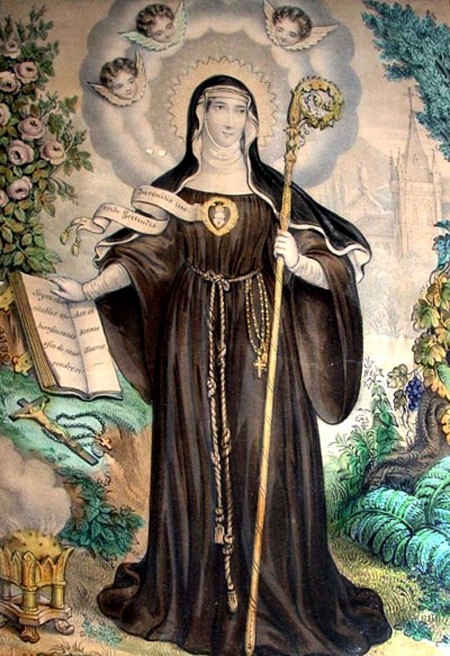
St Gertrude the Great (1256-1301) was a German Benedictine nun and mystic, a forerunner of St Margaret Mary Alacoque in relation to devotion to the sacred heart.

Pope Benedict XVI gave a General Audience on the saint in October 2010:

"St Gertrude the Great, of whom I would like to talk to you today, brings us once again this week to the Monastery of Helfta, where several of the Latin-German masterpieces of religious literature were written by women. Gertrude belonged to this world. She is one of the most famous mystics, the only German woman to be called "Great", because of her cultural and evangelical stature: her life and her thought had a unique impact on Christian spirituality. She was an exceptional woman, endowed with special natural talents and extraordinary gifts of grace, the most profound humility and ardent zeal for her neighbour's salvation. She was in close communion with God both in contemplation and in her readiness to go to the help of those in need.

At Helfta, she measured herself systematically, so to speak, with her teacher, Matilda of Hackeborn, of whom I spoke at last Wednesday's Audience. Gertrude came into contact with Matilda of Magdeburg, another medieval mystic and grew up under the wing of Abbess Gertrude, motherly, gentle and demanding. From these three sisters she drew precious experience and wisdom; she worked them into a synthesis of her own, continuing on her religious journey with boundless trust in the Lord. Gertrude expressed the riches of her spirituality not only in her monastic world, but also and above all in the biblical, liturgical, Patristic and Benedictine contexts, with a highly personal hallmark and great skill in communicating.

Gertrude was born on 6 January 1256, on the Feast of the Epiphany, but nothing is known of her parents nor of the place of her birth. Gertrude wrote that the Lord himself revealed to her the meaning of this first uprooting: "I have chosen you for my abode because I am pleased that all that is lovable in you is my work.... For this very reason I have distanced you from all your relatives, so that no one may love you for reasons of kinship and that I may be the sole cause of the affection you receive" (The Revelations, I, 16, Siena 1994, pp. 76-77).

When she was five years old, in 1261, she entered the monastery for formation and education, a common practice in that period. Here she spent her whole life, the most important stages of which she herself points out. In her memoirs she recalls that the Lord equipped her in advance with forbearing patience and infinite mercy, forgetting the years of her childhood, adolescence and youth, which she spent, she wrote, "in such mental blindness that I would have been capable... of thinking, saying or doing without remorse everything I liked and wherever I could, had you not armed me in advance, with an inherent horror of evil and a natural inclination for good and with the external vigilance of others. "I would have behaved like a pagan... in spite of desiring you since childhood, that is since my fifth year of age, when I went to live in the Benedictine shrine of religion to be educated among your most devout friends" (ibid., II, 23, p. 140f.).

Gertrude was an extraordinary student, she learned everything that can be learned of the sciences of the trivium and quadrivium, the education of that time; she was fascinated by knowledge and threw herself into profane studies with zeal and tenacity, achieving scholastic successes beyond every expectation. If we know nothing of her origins, she herself tells us about her youthful passions: literature, music and song and the art of miniature painting captivated her. She had a strong, determined, ready and impulsive temperament. She often says that she was negligent; she recognizes her shortcomings and humbly asks forgiveness for them. She also humbly asks for advice and prayers for her conversion. Some features of her temperament and faults were to accompany her to the end of her life, so as to amaze certain people who wondered why the Lord had favoured her with such a special love.

From being a student she moved on to dedicate herself totally to God in monastic life, and for 20 years nothing exceptional occurred: study and prayer were her main activities. Because of her gifts she shone out among the sisters; she was tenacious in consolidating her culture in various fields.

Nevertheless during Advent of 1280 she began to feel disgusted with all this and realized the vanity of it all. On 27 January 1281, a few days before the Feast of the Purification of the Virgin, towards the hour of Compline in the evening, the Lord with his illumination dispelled her deep anxiety. With gentle sweetness he calmed the distress that anguished her, a torment that Gertrude saw even as a gift of God, "to pull down that tower of vanity and curiosity which, although I had both the name and habit of a nun alas I had continued to build with my pride, so that at least in this manner I might find the way for you to show me your salvation" (ibid., II, p. 87). She had a vision of a young man who, in order to guide her through the tangle of thorns that surrounded her soul, took her by the hand. In that hand Gertrude recognized "the precious traces of the wounds that abrogated all the acts of accusation of our enemies" (ibid., II, 1, p. 89), and thus recognized the One who saved us with his Blood on the Cross: Jesus.

From that moment her life of intimate communion with the Lord was intensified, especially in the most important liturgical seasons Advent-Christmas, Lent-Easter, the feasts of Our Lady even when illness prevented her from going to the choir. This was the same liturgical humus as that of Matilda, her teacher; but Gertrude describes it with simpler, more linear images, symbols and terms that are more realistic and her references to the Bible, to the Fathers and to the Benedictine world are more direct.

Her biographer points out two directions of what we might describe as her own particular "conversion": in study, with the radical passage from profane, humanistic studies to the study of theology, and in monastic observance, with the passage from a life that she describes as negligent, to the life of intense, mystical prayer, with exceptional missionary zeal. The Lord who had chosen her from her mother's womb and who since her childhood had made her partake of the banquet of monastic life, called her again with his grace "from external things to inner life and from earthly occupations to love for spiritual things". Gertrude understood that she was remote from him, in the region of unlikeness, as she said with Augustine; that she had dedicated herself with excessive greed to liberal studies, to human wisdom, overlooking spiritual knowledge, depriving herself of the taste for true wisdom; she was then led to the mountain of contemplation where she cast off her former self to be reclothed in the new. "From a grammarian she became a theologian, with the unflagging and attentive reading of all the sacred books that she could lay her hands on or contrive to obtain. She filled her heart with the most useful and sweet sayings of Sacred Scripture. Thus she was always ready with some inspired and edifying word to satisfy those who came to consult her while having at her fingertips the most suitable scriptural texts to refute any erroneous opinion and silence her opponents" (ibid., I, 1, p. 25).

Gertrude transformed all this into an apostolate: she devoted herself to writing and popularizing the truth of faith with clarity and simplicity, with grace and persuasion, serving the Church faithfully and lovingly so as to be helpful to and appreciated by theologians and devout people.

Little of her intense activity has come down to us, partly because of the events that led to the destruction of the Monastery of Helfta. In addition to The Herald of Divine Love and The Revelations, we still have her Spiritual Exercises, a rare jewel of mystical spiritual literature.

In religious observance our Saint was "a firm pillar... a very powerful champion of justice and truth" (ibid., I, 1, p. 26), her biographer says. By her words and example she kindled great fervour in other people. She added to the prayers and penances of the monastic rule others with such devotion and such trusting abandonment in God that she inspired in those who met her an awareness of being in the Lord's presence. In fact, God made her understand that he had called her to be an instrument of his grace. Gertrude herself felt unworthy of this immense divine treasure, and confesses that she had not safeguarded it or made enough of it. She exclaimed: "Alas! If you had given me to remember you, unworthy as I am, by even only a straw, I would have viewed it with greater respect and reverence that I have had for all your gifts!" (ibid., II, 5, p. 100). Yet, in recognizing her poverty and worthlessness she adhered to God's will, "because", she said, "I have so little profited from your graces that I cannot resolve to believe that they were lavished upon me solely for my own use, since no one can thwart your eternal wisdom. Therefore, O Giver of every good thing who has freely lavished upon me gifts so undeserved, in order that, in reading this, the heart of at least one of your friends may be moved at the thought that zeal for souls has induced you to leave such a priceless gem for so long in the abominable mud of my heart" (ibid., II, 5, p. 100f.).

Two favours in particular were dearer to her than any other, as Gertrude herself writes: "The stigmata of your salvation-bearing wounds which you impressed upon me, as it were, like a valuable necklaces, in my heart, and the profound and salutary wound of love with which you marked it.

"You flooded me with your gifts, of such beatitude that even were I to live for 1,000 years with no consolation neither interior nor exterior the memory of them would suffice to comfort me, to enlighten me, to fill me with gratitude. Further, you wished to introduce me into the inestimable intimacy of your friendship by opening to me in various ways that most noble sacrarium of your Divine Being which is your Divine Heart.... To this accumulation of benefits you added that of giving me as Advocate the Most Holy Virgin Mary, your Mother, and often recommended me to her affection, just as the most faithful of bridegrooms would recommend his beloved bride to his own mother" (ibid., II, 23, p. 145).

Looking forward to never-ending communion, she ended her earthly life on 17 November 1301 or 1302, at the age of about 46. In the seventh Exercise, that of preparation for death, St Gertrude wrote: "O Jesus, you who are immensely dear to me, be with me always, so that my heart may stay with you and that your love may endure with me with no possibility of division; and bless my passing, so that my spirit, freed from the bonds of the flesh, may immediately find rest in you. Amen" (Spiritual Exercises, Milan 2006, p. 148).
It seems obvious to me that these are not only things of the past, of history; rather St Gertrude's life lives on as a lesson of Christian life, of an upright path, and shows us that the heart of a happy life, of a true life, is friendship with the Lord Jesus. And this friendship is learned in love for Sacred Scripture, in love for the Liturgy, in profound faith, in love for Mary, so as to be ever more truly acquainted with God himself and hence with true happiness, which is the goal of our life."

Thursday, November 15, 2012

St Albert the Great, memorial (Nov 15)


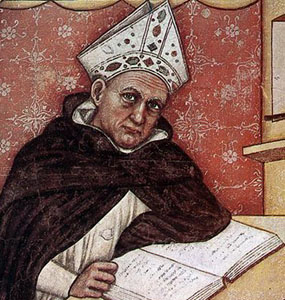
St Albert the Great (1206-1280) was a dominican friar, and bishop of Cologne.

A doctor of the Church, his particular contribution lies in the advocacy of the co-existence of religion and science.

Pope Benedict XVI gave a General Audience on the saint in 2010:

"One of the great masters of medieval theology is St Albert the Great. The title "Great", (Magnus), with which he has passed into history indicates the vastness and depth of his teaching, which he combined with holiness of life. However, his contemporaries did not hesitate to attribute to him titles of excellence even then. One of his disciples, Ulric of Strasbourg, called him the "wonder and miracle of our epoch".

He was born in Germany at the beginning of the 13th century. When he was still young he went to Italy, to Padua, the seat of one of the most famous medieval universities. He devoted himself to the study of the so-called "liberal arts": grammar, rhetoric, dialectics, arithmetic, geometry, astronomy and music, that is, to culture in general, demonstrating that characteristic interest in the natural sciences which was soon to become the favourite field for his specialization. During his stay in Padua he attended the Church of the Dominicans, whom he then joined with the profession of the religious vows. Hagiographic sources suggest that Albert came to this decision gradually. His intense relationship with God, the Dominican Friars' example of holiness, hearing the sermons of Blessed Jordan of Saxony, St Dominic's successor at the Master General of the Order of Preachers, were the decisive factors that helped him to overcome every doubt and even to surmount his family's resistence. God often speaks to us in the years of our youth and points out to us the project of our life. As it was for Albert, so also for all of us, personal prayer, nourished by the Lord's word, frequent reception of the Sacraments and the spiritual guidance of enlightened people are the means to discover and follow God's voice. He received the religious habit from Bl. Jordan of Saxony.

After his ordination to the priesthood, his superiors sent him to teach at various theological study centres annexed to the convents of the Dominican Fathers. His brilliant intellectual qualities enabled him to perfect his theological studies at the most famous university in that period, the University of Paris. From that time on St Albert began his extraordinary activity as a writer that he was to pursue throughout his life.

Prestigious tasks were assigned to him. In 1248 he was charged with opening a theological studium at Cologne, one of the most important regional capitals of Germany, where he lived at different times and which became his adopted city. He brought with him from Paris an exceptional student, Thomas Aquinas. The sole merit of having been St Thomas' teacher would suffice to elicit profound admiration for St Albert. A relationship of mutual esteem and friendship developed between these two great theologians, human attitudes that were very helpful in the development of this branch of knowlege. In 1254, Albert was elected Provincial of the Dominican Fathers' "Provincia Teutoniae" Teutonic Province which included communities scattered over a vast territory in Central and Northern Europe. He distinguished himself for the zeal with which he exercised this ministry, visiting the communities and constantly recalling his confreres to fidelity, to the teaching and example of St Dominic.

His gifts did not escape the attention of the Pope of that time, Alexander iv, who wanted Albert with him for a certain time at Anagni where the Popes went frequently in Rome itself and at Viterbo, in order to avail himself of Albert's theological advice. The same Supreme Pontiff appointed Albert Bishop of Regensburg, a large and celebrated diocese, but which was going through a difficult period. From 1260 to 1262, Albert exercised this ministry with unflagging dedication, succeeding in restoring peace and harmony to the city, in reorganizing parishes and convents and in giving a new impetus to charitable activities.

In the year 1263-1264, Albert preached in Germany and in Bohemia, at the request of Pope Urban iv. He later returned to Cologne and took up his role as lecturer, scholar and writer. As a man of prayer, science and charity, his authoritative intervention in various events of the Church and of the society of the time were acclaimed: above all, he was a man of reconciliation and peace in Cologne, where the Archbishop had run seriously foul of the city's institutions; he did his utmost during the Second Council of Lyons, in 1274, summoned by Pope Gregory X, to encourage union between the Latin and Greek Churches after the separation of the great schism with the East in 1054. He also explained the thought of Thomas Aquinas which had been the subject of objections and even quite unjustified condemnations.

He died in his cell at the convent of the Holy Cross, Cologne, in 1280, and was very soon venerated by his confreres. The Church proposed him for the worship of the faithful with his beatification in 1622 and with his canonization in 1931, when Pope Pius XI proclaimed him Doctor of the Church. This was certainly an appropriate recognition of this great man of God and outstanding scholar, not only of the truths of the faith but of a great many other branches of knowledge; indeed, with a glance at the titles of his very numerous works, we realize that there was something miraculous about his culture and that his encyclopedic interests led him not only to concern himself with philosophy and theology, like other contemporaries of his, but also with every other discipline then known, from physics to chemistry, from astronomy to minerology, from botany to zoology. For this reason Pope Pius XII named him Patron of enthusiasts of the natural sciences and also called him "Doctor universalis" precisely because of the vastness of his interests and knowledge.

Of course, the scientific methods that St Albert the Great used were not those that came to be established in the following centuries. His method consisted simply in the observation, description and classification of the phenomena he had studied, but it was in this way that he opened the door for future research.

He still has a lot to teach us. Above all, St Albert shows that there is no opposition between faith and science, despite certain episodes of misunderstanding that have been recorded in history. A man of faith and prayer, as was St Albert the Great, can serenely foster the study of the natural sciences and progress in knowledge of the micro- and macrocosm, discovering the laws proper to the subject, since all this contributes to fostering thirst for and love of God. The Bible speaks to us of creation as of the first language through which God who is supreme intelligence, who is the Logos reveals to us something of himself. The Book of Wisdom, for example, says that the phenomena of nature, endowed with greatness and beauty, is like the works of an artist through which, by analogy, we may know the Author of creation (cf. Wis 13: 5). With a classical similitude in the Middle Ages and in the Renaissance one can compare the natural world to a book written by God that we read according to the different approaches of the sciences (cf. Address to the participants in the Plenary Meeting of the Pontifical Academy of Sciences, 31 October 2008; L'Osservatore Romano English edition, 5 November 2008, p. 6). How many scientists, in fact, in the wake of St Albert the Great, have carried on their research inspired by wonder at and gratitude for a world which, to their eyes as scholars and believers, appeared and appears as the good work of a wise and loving Creator! Scientific study is then transformed into a hymn of praise. Enrico Medi, a great astrophysicist of our time, whose cause of beatification has been introduced, wrote: "O you mysterious galaxies... I see you, I calculate you, I understand you, I study you and I discover you, I penetrate you and I gather you. From you I take light and make it knowledge, I take movement and make it wisdom, I take sparkling colours and make them poetry; I take you stars in my hands and, trembling in the oneness of my being, I raise you above yourselves and offer you in prayer to the Creator, that through me alone you stars can worship" (Le Opere. Inno alla creazione).

St Albert the Great reminds us that there is friendship between science and faith and that through their vocation to the study of nature, scientists can take an authentic and fascinating path of holiness.

His extraordinary openmindedness is also revealed in a cultural feat which he carried out successfully, that is, the acceptance and appreciation of Aristotle's thought. In St Albert's time, in fact, knowledge was spreading of numerous works by this great Greek philosopher, who lived a quarter of a century before Christ, especially in the sphere of ethics and metaphysics. They showed the power of reason, explained lucidly and clearly the meaning and structure of reality, its intelligibility and the value and purpose of human actions. St Albert the Great opened the door to the complete acceptance in medieval philosophy and theology of Aristotle's philosophy, which was subsequently given a definitive form by St Thomas. This reception of a pagan pre-Christian philosophy, let us say, was an authentic cultural revolution in that epoch. Yet many Christian thinkers feared Aristotle's philosophy, a non-Christian philosophy, especially because, presented by his Arab commentators, it had been interpreted in such a way, at least in certain points, as to appear completely irreconcilable with the Christian faith. Hence a dilemma arose: are faith and reason in conflict with each other or not?

This is one of the great merits of St Albert: with scientific rigour he studied Aristotle's works, convinced that all that is truly rational is compatible with the faith revealed in the Sacred Scriptures. In other words, St Albert the Great thus contributed to the formation of an autonomous philosophy, distinct from theology and united with it only by the unity of the truth. So it was that in the 13th century a clear distinction came into being between these two branches of knowledge, philosophy and theology, which, in conversing with each other, cooperate harmoniously in the discovery of the authentic vocation of man, thirsting for truth and happiness: and it is above all theology, that St Albert defined as "emotional knowledge", which points out to human beings their vocation to eternal joy, a joy that flows from full adherence to the truth.

St Albert the Great was capable of communicating these concepts in a simple and understandable way. An authentic son of St Dominic, he willingly preached to the People of God, who were won over by his words and by the example of his life.

Dear brothers and sisters, let us pray the Lord that learned theologians will never be lacking in holy Church, wise and devout like St Albert the Great, and that he may help each one of us to make our own the "formula of holiness" that he followed in his life: "to desire all that I desire for the glory of God, as God desires for his glory all that he desires", in other words always to be conformed to God's will, in order to desire and to do everything only and always for his glory. "

Tuesday, November 13, 2012

All Saints and All Souls of the Benedictine Order (Nov.13&14)


Most of the major religious orders have a separate celebration for All Saints and All Souls of their Order. 

Being older than most, the Benedictine Order has rather more recognized saints than most - over 1500 according to the 1919 Catholic Encyclopaedia (and there have been quite a number added to the list since then years).  Nonetheless, on this day I always like to think not just of the formally recognized saints, but also of all those countless unrecognized monks, nuns and oblates who lived their lives quietly, faithful to their vocation, and received their reward.

Unfortunately, the monastic life is not a guarantee of either salvation or even instant sainthood, so remember too in your prayers those who have made it thus far only to purgatory...

Monday, November 12, 2012

St Mennas (November 12)


Saint Mennas (285 – c. 309) was born in Egypt to Christian parents, and his father was a senior bureaucrat.  He joined the Roman army at 15 and served for three years, but then left to become a  hermit.

He was martyred after receiving a vision that encouraged him to declare his faith to the then ruler of the area:

"After spending five years as a hermit, Menas saw in a revelation the angels crowning the martyrs with glamorous crowns, and longed to join those martyrs. While he was thinking about it, he heard a voice saying: "Blessed are you Menas because you have been called to the pious life from your childhood. You shall be granted three immortal crowns; one for your celibacy, another for your asceticism, and a third for your martyrdom." Menas subsequently hurried to the ruler, declaring his Christian faith. His endless sufferings and the tortures that he went through, have attracted many of the pagans, not only to Christianity, but also to martyrdom."

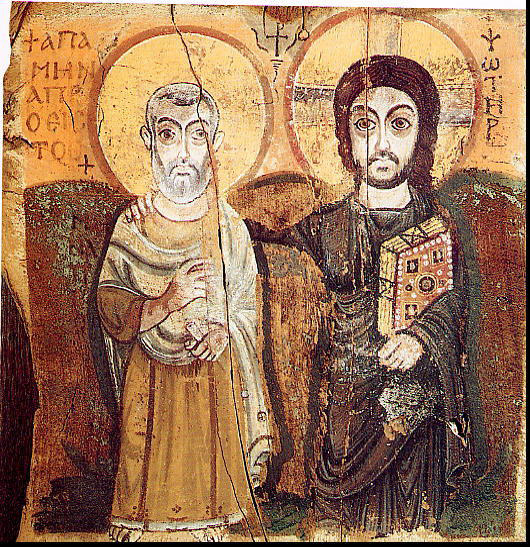
Many miracles were worked through his relics (his body was preserved by his sister), and he was an extremely popular saint for centuries.  Indeed, the sixth century icon above, currently in the Louvre, is reputedly one of the oldest in existence.

Saturday, November 10, 2012

Benedictine Office tips 1: The Collect

I thought I'd start an occasional new series for the benefit of those who are learning to say the traditional Benedictine Office, just focusing on those key things that people often get confused about, particularly when starting out.  Today, the collect in the Office.

Which prayer to use?

If you learning to say the Office, working out which collect, or prayer, to use at the conclusion of each hour is important, because it is one of the things that is not set out in the 'psalter' section of most Office books and generally has to be found elsewhere.

Indeed, to know which collect to use, you will generally need to consult an Ordo, or liturgical calendar, such as the one provided on this blog.  Still, there are some simple rules that will help you get it right, or work it out for yourself.

Fixed collects

The easiest collects to get right and those that are pretty much fixed, namely:
  • the collects for Prime and Compline, which are the same every day, with a few notable exceptions (viz, Maundy Thursday to Holy Saturday and All Souls Days);
  • the collect for the Office of Our Lady on Saturday, used from Matins to None on every Saturday that is Class IV (ie not a feastday or during Advent or Lent).
Similarly, on saints feast days - that is days labelled Class III, Class II or Class I in the calendar - the collect will be that of the feast at all of the hours except Prime and Compline.  If you keep a ribbon in the 'saints section' of the Diurnal, you should be able to keep track of these (note though that memorials only affect Lauds, so I will deal with them separately).

It is also worth noting that where a feast is first class, it will generally have a  'I Vespers' (just as Sundays do) and the collect at that previous day's Vespers will be for the feast.

Throughout the year - default to Sunday!

On days that aren't feastdays, for most the year (ie in time throughout the year) the normal default is to use the collect of the Sunday. 

During the week, it is the collect of the previous Sunday; at Saturday Vespers (ie I Vespers of Sunday), it is the collect for the next day.

The collects are provided in the Diurnal and breviaries in the front section of the book, listed according to the Sunday of the year.  Indeed, the collect used in the Office is typically the same as the collect used in the Extraordinary Form Mass.   And if you normally attend an OF Mass, you could legitimately substitute in the collect from that Mass in its place (the problem with doing that is that the Sunday Benedictus and Magnificat antiphons should also match up with the OF Gospel.  Official versions of them are available in Latin, in the new Monastic Antiphonale put out by Solesmes).

That means of course, that you need to keep track of what Sunday it is!  If you don't have access to an Ordo of some kind, you can (with some effort) work it out for yourself by using the table of  'moveable feasts' in the front matter of the Diurnal and counting Sundays. 

When things get more complicated....

The exceptions to the 'use Sunday's' collect rule are:
  • as previously suggested, feasts of saints;
  • certain 'moveable feasts' included in the front section of the Diurnal and breviary, such as Corpus Christi, assorted Ember Days and the like; and
  • times of the year when the liturgy becomes more intense, such as Advent and Lent.
Hope this helps rather than confuses!

Saturday, October 20, 2012

St John Cantius (EF, Oct 20)


"In Poland, St. John Cantius, priest and confessor. Being glorious for virtues and miracles, he was inscribed among the saints by the Sovereign Pontiff, Clement XIII."


Thursday, October 18, 2012

St Luke the Evangelist (EF/OF/Ben, Oct 18)


"The birthday of blessed Luke, Evangelist, who, after having suffered much for the name of Christ, died in Bithynia, filled with the Holy Ghost. His relics were taken to Constantinople, and thence conveyed to Padua."


Monday, October 15, 2012

St Teresa of Avila (EF/OF/Ben, Oct 15)


Today's saint is one of that expanding band of female doctors of the Church, St Teresa of Avila.

From the martyrology:

"At Avila, in Spain, St. Theresa, virgin, mother and mistress of the Carmelite Brothers and Sisters of the Strict Observance."

Pope Benedict XVI gave a General Audience on her in 2011:

"St Teresa, whose name was Teresa de Cepeda y Ahumada, was born in Avila, Spain, in 1515. In her autobiography she mentions some details of her childhood: she was born into a large family, her “father and mother, who were devout and feared God”, into a large family. She had three sisters and nine brothers.

While she was still a child and not yet nine years old she had the opportunity to read the lives of several Martyrs which inspired in her such a longing for martyrdom that she briefly ran away from home in order to die a Martyr’s death and to go to Heaven (cf. Vida, [Life], 1, 4); “I want to see God”, the little girl told her parents.

A few years later Teresa was to speak of her childhood reading and to state that she had discovered in it the way of truth which she sums up in two fundamental principles.

On the one hand was the fact that “all things of this world will pass away” while on the other God alone is “for ever, ever, ever”, a topic that recurs in her best known poem: “Let nothing disturb you, Let nothing frighten you, All things are passing away: God never changes. Patience obtains all things. Whoever has God lacks nothing; God alone suffices”. She was about 12 years old when her mother died and she implored the Virgin Most Holy to be her mother (cf. Vida, I, 7).

If in her adolescence the reading of profane books had led to the distractions of a worldly life, her experience as a pupil of the Augustinian nuns of Santa María de las Gracias de Avila and her reading of spiritual books, especially the classics of Franciscan spirituality, introduced her to recollection and prayer.

When she was 20 she entered the Carmelite Monastery of the Incarnation, also in Avila. In her religious life she took the name “Teresa of Jesus”. Three years later she fell seriously ill, so ill that she remained in a coma for four days, looking as if she were dead (cf. Vida, 5, 9).

In the fight against her own illnesses too the Saint saw the combat against weaknesses and the resistance to God’s call: “I wished to live”, she wrote, “but I saw clearly that I was not living, but rather wrestling with the shadow of death; there was no one to give me life, and I was not able to take it. He who could have given it to me had good reasons for not coming to my aid, seeing that he had brought me back to himself so many times, and I as often had left him” (Vida, 7, 8).

In 1543 she lost the closeness of her relatives; her father died and all her siblings, one after another, emigrated to America. In Lent 1554, when she was 39 years old, Teresa reached the climax of her struggle against her own weaknesses. The fortuitous discovery of the statue of “a Christ most grievously wounded”, left a deep mark on her life (cf. Vida, 9).

The Saint, who in that period felt deeply in tune with the St Augustine of the Confessions, thus describes the decisive day of her mystical experience: “and... a feeling of the presence of God would come over me unexpectedly, so that I could in no wise doubt either that he was within me, or that I was wholly absorbed in him” (Vida, 10, 1).

Parallel to her inner development, the Saint began in practice to realize her ideal of the reform of the Carmelite Order: in 1562 she founded the first reformed Carmel in Avila, with the support of the city’s Bishop, Don Alvaro de Mendoza, and shortly afterwards also received the approval of John Baptist Rossi, the Order’s Superior General.

In the years that followed, she continued her foundations of new Carmelite convents, 17 in all. Her meeting with St John of the Cross was fundamental. With him, in 1568, she set up the first convent of Discalced Carmelites in Duruelo, not far from Avila.

In 1580 she obtained from Rome the authorization for her reformed Carmels as a separate, autonomous Province. This was the starting point for the Discalced Carmelite Order.

Indeed, Teresa’s earthly life ended while she was in the middle of her founding activities. She died on the night of 15 October 1582 in Alba de Tormes, after setting up the Carmelite Convent in Burgos, while on her way back to Avila. Her last humble words were: “After all I die as a child of the Church”, and “O my Lord and my Spouse, the hour that I have longed for has come. It is time to meet one another”.

Teresa spent her entire life for the whole Church although she spent it in Spain. She was beatified by Pope Paul V in 1614 and canonized by Gregory XV in 1622. The Servant of God Paul VI proclaimed her a “Doctor of the Church” in 1970.

Teresa of Jesus had no academic education but always set great store by the teachings of theologians, men of letters and spiritual teachers. As a writer, she always adhered to what she had lived personally through or had seen in the experience of others (cf. Prologue to The Way of Perfection), in other words basing herself on her own first-hand knowledge.

Teresa had the opportunity to build up relations of spiritual friendship with many Saints and with St John of the Cross in particular. At the same time she nourished herself by reading the Fathers of the Church, St Jerome, St Gregory the Great and St Augustine.

Among her most important works we should mention first of all her autobiography, El libro de la vida (the book of life), which she called Libro de las misericordias del Señor [book of the Lord’s mercies].

Written in the Carmelite Convent at Avila in 1565, she describes the biographical and spiritual journey, as she herself says, to submit her soul to the discernment of the “Master of things spiritual”, St John of Avila. Her purpose was to highlight the presence and action of the merciful God in her life. For this reason the work often cites her dialogue in prayer with the Lord. It makes fascinating reading because not only does the Saint recount that she is reliving the profound experience of her relationship with God but also demonstrates it.

In 1566, Teresa wrote El Camino de Perfección [The Way of Perfection]. She called it Advertencias y consejos que da Teresa de Jesús a sus hermanas [recommendations and advice that Teresa of Jesus offers to her sisters]. It was composed for the 12 novices of the Carmel of St Joseph in Avila. Teresa proposes to them an intense programme of contemplative life at the service of the Church, at the root of which are the evangelical virtues and prayer.

Among the most precious passages is her commentary on the Our Father, as a model for prayer. St Teresa’s most famous mystical work is El Castillo interior [The Interior Castle]. She wrote it in 1577 when she was in her prime. It is a reinterpretation of her own spiritual journey and, at the same time, a codification of the possible development of Christian life towards its fullness, holiness, under the action of the Holy Spirit.

Teresa refers to the structure of a castle with seven rooms as an image of human interiority. She simultaneously introduces the symbol of the silk worm reborn as a butterfly, in order to express the passage from the natural to the supernatural.

The Saint draws inspiration from Sacred Scripture, particularly the Song of Songs, for the final symbol of the “Bride and Bridegroom” which enables her to describe, in the seventh room, the four crowning aspects of Christian life: the Trinitarian, the Christological, the anthropological and the ecclesial.

St Teresa devoted the Libro de la fundaciones [book of the foundations], which she wrote between 1573 and 1582, to her activity as Foundress of the reformed Carmels. In this book she speaks of the life of the nascent religious group. This account, like her autobiography, was written above all in order to give prominence to God’s action in the work of founding new monasteries.

It is far from easy to sum up in a few words Teresa’s profound and articulate spirituality. I would like to mention a few essential points. In the first place St Teresa proposes the evangelical virtues as the basis of all Christian and human life and in particular, detachment from possessions, that is, evangelical poverty, and this concerns all of us; love for one another as an essential element of community and social life; humility as love for the truth; determination as a fruit of Christian daring; theological hope, which she describes as the thirst for living water. Then we should not forget the human virtues: affability, truthfulness, modesty, courtesy, cheerfulness, culture.

Secondly, St Teresa proposes a profound harmony with the great biblical figures and eager listening to the word of God. She feels above all closely in tune with the Bride in the Song of Songs and with the Apostle Paul, as well as with Christ in the Passion and with Jesus in the Eucharist. The Saint then stresses how essential prayer is. Praying, she says, “means being on terms of friendship with God frequently conversing in secret with him who, we know, loves us” (Vida 8, 5). St Teresa’s idea coincides with Thomas Aquinas’ definition of theological charity as “amicitia quaedam hominis ad Deum”, a type of human friendship with God, who offered humanity his friendship first; it is from God that the initiative comes (cf. Summa Theologiae II-II, 23, 1).

Prayer is life and develops gradually, in pace with the growth of Christian life: it begins with vocal prayer, passes through interiorization by means of meditation and recollection, until it attains the union of love with Christ and with the Holy Trinity. Obviously, in the development of prayer climbing to the highest steps does not mean abandoning the previous type of prayer. Rather, it is a gradual deepening of the relationship with God that envelops the whole of life.

Rather than a pedagogy Teresa’s is a true “mystagogy” of prayer: she teaches those who read her works how to pray by praying with them. Indeed, she often interrupts her account or exposition with a prayerful outburst.

Another subject dear to the Saint is the centrality of Christ’s humanity. For Teresa, in fact, Christian life is the personal relationship with Jesus that culminates in union with him through grace, love and imitation. Hence the importance she attaches to meditation on the Passion and on the Eucharist as the presence of Christ in the Church for the life of every believer, and as the heart of the Liturgy. St Teresa lives out unconditional love for the Church: she shows a lively “sensus Ecclesiae”, in the face of the episodes of division and conflict in the Church of her time.

She reformed the Carmelite Order with the intention of serving and defending the “Holy Roman Catholic Church”, and was willing to give her life for the Church (cf. Vida, 33,5).

A final essential aspect of Teresian doctrine which I would like to emphasize is perfection, as the aspiration of the whole of Christian life and as its ultimate goal. The Saint has a very clear idea of the “fullness” of Christ, relived by the Christian. At the end of the route through The Interior Castle, in the last “room”, Teresa describes this fullness, achieved in the indwelling of the Trinity, in union with Christ through the mystery of his humanity.

Dear brothers and sisters, St Teresa of Jesus is a true teacher of Christian life for the faithful of every time. In our society, which all too often lacks spiritual values, St Teresa teaches us to be unflagging witnesses of God, of his presence and of his action. She teaches us truly to feel this thirst for God that exists in the depths of our hearts, this desire to see God, to seek God, to be in conversation with him and to be his friends.

This is the friendship we all need that we must seek anew, day after day. May the example of this Saint, profoundly contemplative and effectively active, spur us too every day to dedicate the right time to prayer, to this openness to God, to this journey, in order to seek God, to see him, to discover his friendship and so to find true life; indeed many of us should truly say: “I am not alive, I am not truly alive because I do not live the essence of my life”.

Therefore time devoted to prayer is not time wasted, it is time in which the path of life unfolds, the path unfolds to learning from God an ardent love for him, for his Church, and practical charity for our brothers and sisters."